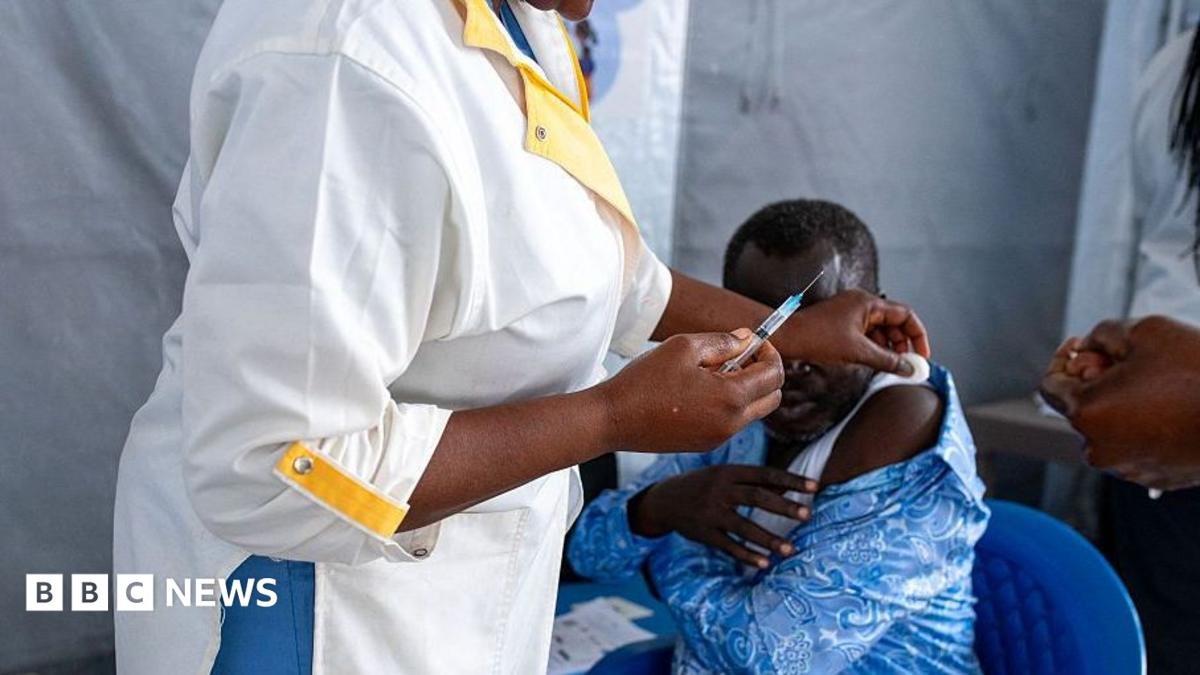
Image source, AFP via Getty Images Image caption, MSF says that many frontline workers do not have the equipment they need ByBasillioh Rukanga Published 12 November 2026, 12:54 GMT Updated 3 hours ago Hundreds of millions of dollars meant to help tackle Ebola in the Democratic Republic of Congo are not reaching the intended recipients, a medical charity has warned.
A report from Médecins Sans Frontières (MSF) said that while the outbreak remained "out of control", front-line workers were going unpaid, lacked proper training and were struggling with shortages of essential supplies.
It added that in some cases ambulances had run out of fuel.
More than 5,400 people have died and 11,000 infected with Ebola in DR Congo since the outbreak was declared in May.
This makes it the second-most deadly outbreak of the disease ever recorded.
MSF has urged the Congolese government and UN agencies to "strengthen oversight and accountability" to ensure money already disbursed is effectively utilised.
This means "ensuring response personnel are properly trained, paid, equipped, and supported, and directing resources towards areas where needs are greatest", it said.
The BBC has asked the Congolese government for comment.
MSF's warning adds to concerns raised by Africa Centres for Disease Control and Prevention (Africa CDC) last month, when it said that $700m (£527m) out of $962m disbursed to organisations implementing Ebola response was unaccounted for.
At the time, Africa CDC chief Jean Kaseya said it was too early to describe it as embezzlement, characterising the issue as a major transparency and financial reporting failure.
The Congolese health minister echoed these concerns, saying that aid agencies were required to provide details of their work so the ministry could provide oversight but that only 22% had done so.
"Our requirement is clear: transparency must be total.
The response relies on a single plan, a single budget, and a single coordination," Health Minister Samuel-Roger Kamba said on X., external What is Ebola and why is stopping the latest outbreak so difficult?
Published 15 September In its report, external, the charity said: "Despite the vast amounts of money provided for the response, many frontline responders are left trying to contain the outbreak with empty hands and empty pockets." It also mentioned Ebola monitoring "surveillance teams that exist on paper but are nowhere to be seen on the ground".
"Our teams are often left speechless by the dysfunctions they witness in many areas.
Six months into the response, this situation is simply unacceptable," said MSF president Javid Abdelmoneim.
One important way of stopping Ebola from spreading is contact tracing - finding all those people who had come into contact with an infected person and putting them into isolation.
"Despite the resources officially allocated to this critical activity, surveillance remains deeply problematic," MSF said, adding that two-thirds of deaths were occurring in communities not treatment centres.
According to British epidemiologist Neil Ferguson, more than half of the cases are going undetected, meaning the outbreak is likely to last another year, reports the Reuters news agency.
MSF also raised concerns over "excessive concentration" of efforts in certain areas at the expense of other areas where needs were more urgent.
It said the response was "too slow" in North Kivu province while Haut-Uélé remained "dramatically overlooked".
In both provinces, MSF observed that teams were "inadequately resourced to respond effectively" with health facilities lacking essential items such as water, chlorine or triage systems.
"This has turned some facilities into new centres of transmission, rather than places of care that contribute to containing the disease," MSF said.
The epicentre of the outbreak is in eastern DR Congo, which has been wracked by conflict for many decades, with some affected areas under rebel control.
There are very few good roads in the area, making it very hard to travel around.
On Thursday, the UN and government warned that the areas worst affected by Ebola were also suffering from a severe food crisis, with almost 10 million in the region in dire need.
The latest outbreak, caused by the Bundibugyo species of the virus, has spread beyond DR Congo borders, with cases reported in Kenya, Uganda and Nigeria.
On Wednesday, the last person infected with Ebola in Kenya was discharged, marking a major milestone in efforts to contain the disease in the East African nation.
The Bundibugyo species is relatively rare and has no approved vaccine or treatment - though trials are under way.
Additional reporting by Emery Makumeno in Kinshasa More about the Ebola outbreak from the BBC: Questions remain over Ebola patient who travelled across three nations undetected Published 10 October 'They said it isn't real': Ebola rumours fuel attacks on health workers Published 9 July 'I buried my parents one day after the other' - Ebola mourners learn how to grieve safely Published 18 June Go to BBCAfrica.com, external for more news from the African continent.